
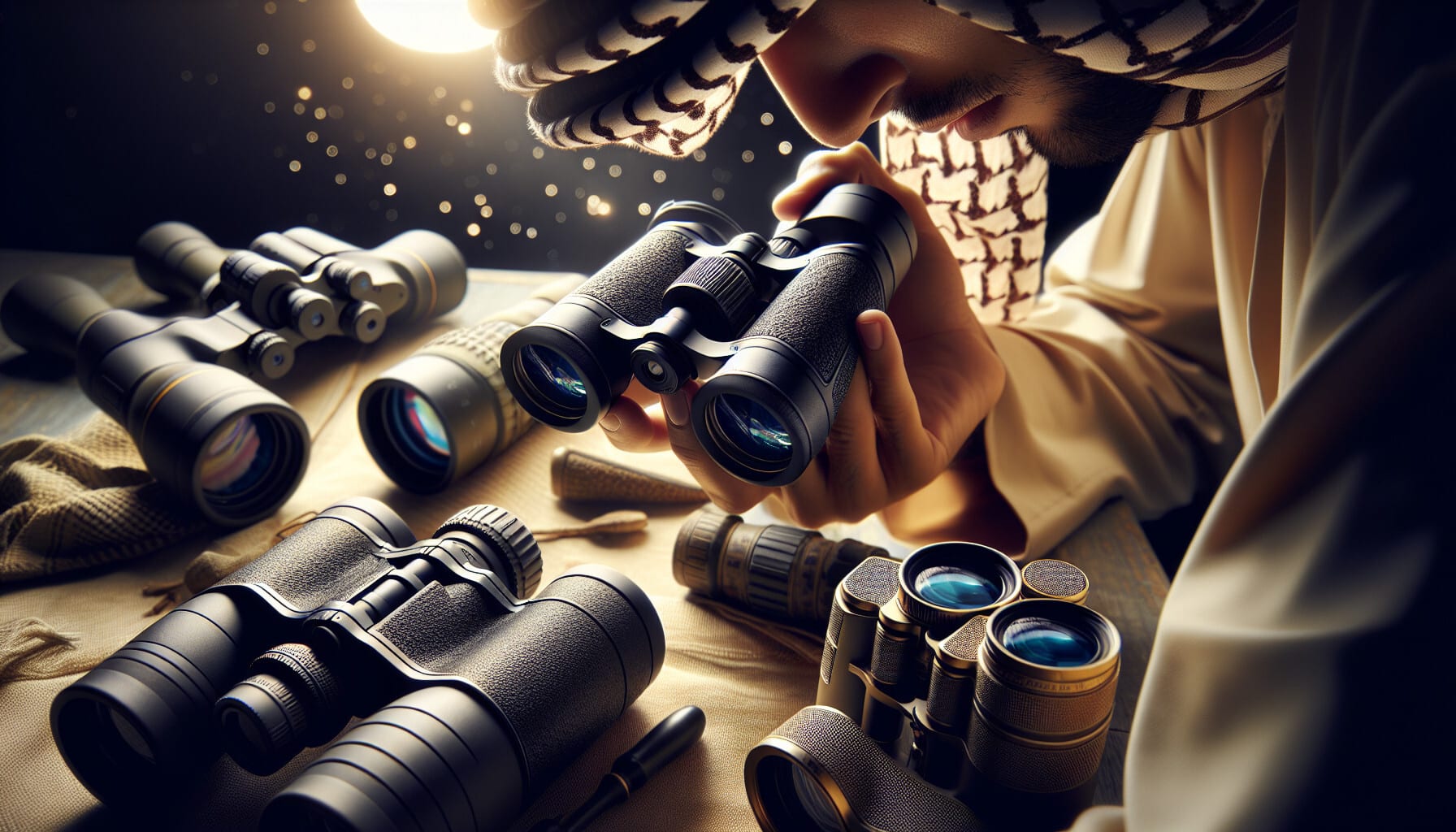


On any big game hunting trip, and on many outings for small game and waterfowl as well, next to your rifle, shotgun, or bow, a good pair of binoculars may be the most important piece of equipment you bring.
Although most hunters have scopes on their rifles, it is not advisable to use a scoped rifle for glassing. Not only is it dangerous (there’s a rifle sitting underneath that scope, and what you’re seeing could be another person), but there are many good binoculars available at reasonable prices.
Binocular Buying Guide for Hunting in Alaska
Choosing the right binoculars can be challenging due to the variety of models available. This binocular buying guide provides essential information, including key terms used in the optics industry and their significance.
Porro Prism Versus Roof Prism Binoculars
Bushnell PowerView 2 Binoculars
Binoculars utilize either a Porro prism system or a roof prism system, which refers to the configuration of the internal prisms used for magnification and light transmission. Porro prisms feature front or objective lenses that are offset from the eyepiece or ocular lens. While they generally cost less, they tend to be bulkier and heavier.
Tip: The Bushnell PowerView 2 Binoculars are designed for multi-purpose functionality, making them suitable for hunting, bird watching, and general use such as sightseeing.
Roof prism binoculars are more streamlined and compact. Look for roof prisms with phase correction, which prevents interference when light paths cross while being reflected off the internal prism surfaces.
Cabela’s Intensity HD Binoculars
Tip: The Cabela’s Intensity HD Binoculars feature roof prisms and come in 8X, 10X, 12X, and 15X magnification. They are designed to enhance long-range hunting visibility and tine-counting clarity using premium-quality HD extra-low-dispersion (ED) glass.
Understanding Binocular Specifications
Specifications for binoculars are typically stated as 7x35mm, 8x40mm, 10x42mm, etc. The number before the “x” indicates magnification power, meaning the object will appear that many times closer or larger than it actually is.
While higher magnification offers a better view, it also results in a smaller field of view, making it more challenging to scan for game. Most hunters prefer 8x or 10x magnification for a good balance of magnification and field of view, although some opt for 12x.
Anything beyond that may result in a small field of view and could be difficult to hold steady without a tripod, as higher magnification magnifies hand unsteadiness.
Most binoculars are fixed-power, with a permanent magnification level, while a few offer variable power that can be adjusted.
Deciphering the Numbers Following the Magnification
Swarovski SLC Binoculars Roof Prism
The number following the “x” refers to the inside diameter of the objective lens frame, expressed in millimeters. A larger diameter allows for a broader field of view and greater light-gathering capability, which is crucial for brightness.
When comparing binoculars with the same magnification, the one with the larger objective diameter will generally provide a brighter image. High-quality binoculars excel in gathering available light, allowing for better visibility in low-light conditions.
Tip: The Swarovski SLC Binoculars are ideal for hunters, featuring a three-part objective lens that enhances light transmission for superior image quality, even in low light. They also include adjustable eyecups, central dioptic adjustment, and a smooth focusing system in an ergonomic design. Additionally, they are airtight, dustproof, fogproof, and fully waterproof/submersible.
Lens Surface Coating Options for Binoculars
To minimize glare and light loss during transmission, special coatings are applied to lens surfaces. The quality, number, and position of these coatings determine light transmission. Here are the available options:
- Coated — a single layer applied to at least one lens surface
- Fully-coated — a single layer applied to all air-to-glass surfaces
- Multi-coated — multiple layers applied to at least one lens surface
- Fully multi-coated — multiple layers applied to all air-to-glass surfaces
Understanding Exit Pupil Diameter for Binoculars
The brightness, sharpness, and clarity of binoculars depend on several factors, including the diameter of the exit pupils, which is the size of the circle of light visible at the eyepiece when pointed at a light source. The larger the exit pupil (measured in millimeters), the brighter the image will be, all else being equal. To determine this number, divide the objective lens diameter by the magnification (e.g., an 8×32 model has an exit pupil of 4mm).
Full-sized binoculars should ideally have exit pupils in the 4-5mm range. Larger exit pupils may exceed the capacity of the human eye, while smaller ones may result in less brightness.
The pupil diameter of the human eye changes depending on ambient light conditions.
Exceptions to the 4-5mm Exit Pupil Rule
Cabela’s Intensity HD Compact Binoculars
Compact or pocket-sized binoculars, typically with 7x or 8x magnification and objective lenses under 30mm, may not be as bright as full-sized models. However, their convenience makes them a valuable choice for hunters who prefer lightweight options.
Tip: The Cabela’s Intensity HD Compact Binoculars are lightweight, featuring a rubber-armored magnesium-alloy chassis for durability. They include phase and silver-coated roof prisms for enhanced resolution and true-to-life colors. The lenses are fully multicoated with advanced wide-band coating technology, improving light transmission for brighter images in low-light conditions.
Investing in Quality Binoculars for Hunting
The general rule for purchasing binoculars is to invest in the best quality within your budget, which can range from $200 to $2,000. High-quality optics provide clearer, brighter images and reduce eye strain during extended use.
In addition to superior optics, many binoculars are rubber-armored for shock absorption and comfort. Top models are waterproof, fogproof, and shockproof, achieved through O-ring seals and nitrogen gas filling.
Many binoculars also offer diopter adjustments to accommodate differences in vision between the right and left eyes.
Examine each model and test them by looking at distant objects for a few minutes. If eye strain occurs, try another pair. Everyone’s eyes are different, and finding the right balance of brightness, sharpness, and comfort is essential for an enjoyable hunting experience.